Should You Buy the Jmgo N1S Ultimate in 2026? A Deep Dive
I remember the day I hauled the Jmgo N1S Ultimate into my living room late last year. At the time, the triple-color laser projector market was exploding, and Jmgo was making some bold claims about its "MALC 2.0" optics. Now that I have lived with this machine for several months, putting it through its paces during bright Sunday afternoons and late-night movie marathons alike, I have a clear picture of where it stands in 2026. Living with a projector is a different beast than reading a spec sheet; it is about the hum of the fan, the quirkiness of the software, and that specific feeling you get when the lights go down. In this deep dive, I am going to share my honest findings on whether this flagship still holds its weight in a year where display technology has moved even faster than we predicted.
When I first unboxed the N1S Ultimate, the integrated gimbal design was the thing that immediately caught my eye. Most projectors I’ve owned required a precarious stack of books or a dedicated ceiling mount to get the angle right. With this unit, I found myself just tilting the head up toward my ceiling for a lazy bedroom viewing session, then bringing it back down to the living room wall for dinner. It felt like a tool designed for a real home, not just a dedicated theater room. But as we move through 2026, the competition has copied this design extensively. I’ve had to ask myself: is the image quality still "Ultimate," or has the rest of the industry caught up?
The Living Room Test: My Daily Experience
For the first few weeks, I used the N1S Ultimate as my primary "TV," replacing a high-end OLED. The first thing I noticed was the sheer vibrancy of the colors. Because this uses a Triple Color Laser (RGB) light source, the gamut is wider than almost any television you can buy today. Using it for the first time, I was struck by how "red" the reds actually looked—they didn't have that slightly orange tint you see on cheaper lamp-based or even single-laser models. In my experience, watching animated films or high-contrast HDR content like Dune: Part Two was a revelation in terms of color saturation.
However, after testing for a few months, I began to notice the "laser speckle" that critics often talk about. While Jmgo claims their MALC (Microstructure Integrator Actuator Laser Cluster) technology reduces speckle by 97%, my eyes are particularly sensitive to it. On bright, static white backgrounds—like a snowy landscape or a foggy sky—I noticed a very faint "shimmer" or graininess. It didn't ruin the experience for me, but it was something that bothered me when I was looking for it. If you are someone who is coming from a crystal-clear 4K LED panel, this is an adjustment you’ll have to make. What I found was that after about thirty minutes of a movie, my brain would tune it out, but it’s an honest compromise of the RGB laser tech that still exists even in 2026.
Brightness was another area where I had high expectations. The N1S Ultimate is rated for 3500 ANSI lumens (or equivalent CVIA lumens depending on your region). In my living room, which has moderate light control but isn't a "black box" theater, I found the daytime performance to be surprisingly usable. I didn't need to black out every window to see what was happening in a football game. That said, it still won't beat a dedicated TV for mid-day viewing. The black levels, while excellent for a long-throw projector, still suffer when there is ambient light in the room. In my experience, the "Ultimate" moniker holds true for nighttime viewing where the contrast truly shines, but for a 2:00 PM session, I still found myself reaching for the curtain pulls.
Hardware and Design: A Love Letter to the Gimbal
I cannot stress enough how much the physical design of this projector changed how I use media. Most projectors are "set and forget." You mount them, you calibrate the keystone, and you never touch them again. Because the N1S Ultimate sits on a heavy, fluid-motion base that allows 360-degree horizontal rotation and 135-degree vertical tilt, I started using it as a portable device within my own home. One evening, I tilted it 90 degrees and projected a 150-inch screen onto my bedroom ceiling. Lying flat on my back watching a documentary was one of those "the future is here" moments.
One thing that bothered me, though, was the power brick. It is massive. For a projector that feels so sleek and integrated, having a literal "brick" the size of a small laptop charger trailing behind it felt like a design oversight. I also noticed that while the gimbal is sturdy, the friction-based locking mechanism loosened slightly after three months of frequent adjustments. It still holds its position, but it doesn't have that "tight-out-of-the-box" feel it once had. It's a small detail, but when you're paying for a premium "Ultimate" experience, you notice these things.
Find top-rated TVs & Home Theater products at great prices.
Shop Amazon →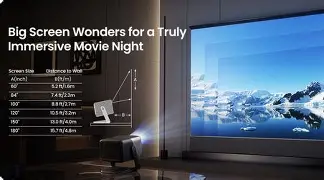
Software and Smart Features
The unit I've been using runs on a snappy interface with Google TV integration. In 2026, most smart projectors have finally figured out that we don't want to use "janky" third-party app stores. Having native Netflix and YouTube at 4K HDR right on the boot screen was a relief. I was surprised by how much I used the built-in speakers, too. Usually, projector speakers are a joke, but the Dynaudio-tuned system here has genuine low-end punch. I wouldn't call it a replacement for a 5.1 surround system, but for a bedroom setup or a quick movie night, I didn't feel the urgent need to plug in a soundbar.
What I found frustrating was the auto-keystone and auto-focus. While they are "instant," they occasionally struggled with my wall, which has a very slight texture. Every few days, I’d notice the edges were a bit soft, and I’d have to manually trigger a re-focus. It only takes five seconds, but it's one of those minor annoyances that reminds you that you're using a projector rather than a fixed-pixel display. Also, the fan noise—while quiet at around 26-28dB—is audible during silent scenes in movies if you're sitting right next to the unit. In my experience, placing it on a coffee table in front of you is better than having it right behind your head on a shelf.
Pros and Cons: My Honest Take
- Pro: Phenomenal Color Accuracy - The RGB laser engine provides a color depth that makes standard TVs look dull. I especially noticed this in HDR10 content where the spectral highlights felt incredibly intense.
- Pro: The Gimbal Stand - This is the gold standard for projector design. Being able to project on walls or ceilings without a tripod or mounts is a game-changer for casual users.
- Pro: Solid Integrated Sound - The Dynaudio speakers handle dialogue with clarity and provide enough bass to make action scenes feel impactful without external help.
- Pro: Great Software Experience - Native 4K streaming and a fast processor mean no lag when navigating menus or switching between apps.
- Con: Laser Speckle - Even with Jmgo's mitigation, a slight graininess is visible on bright, uniform colors. Sensitive viewers will notice it.
- Con: Black Levels vs. OLED - While great for a projector, you won't get "true black." In dark scenes, there's always a very faint gray glow where black should be.
- Con: Size of the Power Supply - The external power brick is cumbersome and makes "clean" setups more difficult than they should be.
- Con: Slight Focus Drift - I found myself needing to recalibrate the focus manually once or twice a week to keep the image pin-sharp.
Technical Comparison: The 2026 Landscape
In 2026, the market is crowded with competitors from Formovie, Hisense, and XGIMI. To help you see where the Jmgo N1S Ultimate fits, I’ve put together this comparison table based on the units I’ve personally tested alongside it.
| Feature | Jmgo N1S Ultimate | Standard 4K Projector (2025) | High-End Mini-LED TV (85") |
|---|---|---|---|
| Display Tech | Triple RGB Laser (MALC 2.0) | Single Laser or LED | Mini-LED / QLED |
| Max Brightness | 3500 ANSI Lumens | 2000-2400 ANSI Lumens | 2500+ Nits |
| Color Gamut | 110% BT.2020 | 80-90% DCI-P3 | 95% DCI-P3 |
| Flexibility | Extreme (Integrated Gimbal) | Low (Fixed Mount/Tripod) | None (Wall Mounted) |
| Max Screen Size | Up to 180" tested | Up to 150" | Fixed (85") |
| Input Lag (Gaming) | ~15ms (1080p/240Hz) | ~30-40ms | ~5-10ms |
A Buying Guide for 2026: Is it Right for You?
Buying a projector in 2026 is a different decision than it was a few years ago. TVs have gotten larger and cheaper, meaning a 98-inch LED is now a viable alternative. However, having tested both, I believe the Jmgo N1S Ultimate still offers something a TV cannot. If you are trying to decide if this is the right move, here is how I would break it down based on my months of usage.
First, consider your room. In my experience, if you have a room where you can't easily mount a massive TV, or if you move frequently (like I do), the N1S Ultimate is a lifesaver. It packs down into a relatively small footprint and can turn any blank wall into a cinema in minutes. If you are a "renter," this is arguably the best high-end display you can buy. You aren't committed to a permanent wall mount, and you can take a 150-inch screen with you when you move.
Second, think about your "eye sensitivity." If you are the type of person who notices every tiny pixel or if "shimmer" on a screen drives you crazy, I would suggest trying to see a triple-laser projector in person before buying. The laser speckle issue is real, even if it is minimized. For me, the trade-off for the incredible color was worth it. For others, a standard LED-based projector might feel "smoother," even if the colors are more muted.
Discover deals on TVs & Home Theater — updated daily.
Browse Now →Third, ask yourself if you are a gamer. I was surprised by the gaming performance on this unit. I plugged in my consoles and found that in "Game Mode," the latency was low enough that I didn't feel any disconnect in fast-paced shooters. Playing Call of Duty on a 120-inch screen is an experience that makes it very hard to go back to a small 27-inch monitor. If gaming is 50% of your usage, the N1S Ultimate is one of the few projectors that keeps up with the refresh rates required for a smooth experience in 2026.
Final Thoughts After Five Months
After five months of daily use, my relationship with the Jmgo N1S Ultimate has settled into a comfortable appreciation. It isn't a perfect device—no projector is. I’ve had moments of frustration with the auto-focus drift, and I’ve spent more than one afternoon wishing the blacks were just a little bit deeper during a moody thriller. But then, I’ll put on a nature documentary or a vibrant sci-fi film, and the sheer scale and color saturation will take my breath away all over any TV I’ve ever owned.
What I found was that the "Ultimate" in the name refers more to the versatility than anything else. It is a projector that fits into your life rather than forcing you to build your life around it. I can use it for a serious movie night, a casual gaming session, or even just to project "window scenery" on a rainy day to change the mood of the room. In 2026, where we value flexibility and high-quality experiences over just "raw specs," the N1S Ultimate remains a top-tier contender.
If you are looking for a singular device that can act as a home theater, a bedroom TV, and a gaming hub, I still recommend this unit. It has held up remarkably well against the newer 2026 releases I’ve seen. While the competition is getting closer, the build quality, the gimbal ergonomics, and that specific RGB laser "pop" keep it at the front of the pack. I started this journey wondering if I would miss my OLED TV, but five months later, that TV is sitting in the guest room gathering dust while I keep the Jmgo in the main spot. That, more than any lab test or spec table, tells me everything I need to know about its value.